Sunday, 2 August 2015

Ant-Man; Now with more ants

You can read part one (Myremecology-Man) here. I'd recommend it, you'd probably understand a little bit better what I'm writing about today!

A quick recap;

  • I went to see Ant-Man, it was pretty good, but there were a few niggly bits that caught me regarding the ants' behaviour.
  • They concentrated on 4 species; fire ants, bullet ants, crazy ants and carpenter ants. Today is crazy ant and carpenter ant time.
  • There was too much Hank Pym. Boo, hiss.
Today's specialty is part two; cool critters called C cognomens*.

Hey look, a .gif with both species of the day. Fancy!

*I had to thesaurus that. Cognomen means 'nicknames". 

Crazy ants

First up, we have the crazy ants. Before you ask, yes, they are actually a thing, and yes, they are called crazy ants. Obviously catering to an American audience, Marvel picked the four species most people would know of; although the UK probably laughs at this one, as they do sound like they're made up. Nylanderia fulva doesn't roll off the tongue quite as easily though. 
Crazy ants are called crazy because they act very erratically when disturbed, freaking out all over the place. The ones in the film are probably Rasberry crazy ants (I am not making this up, I swear); other species within this family are Yellow crazy ants and Longhorn crazy ants

Close encounters of the ant kind

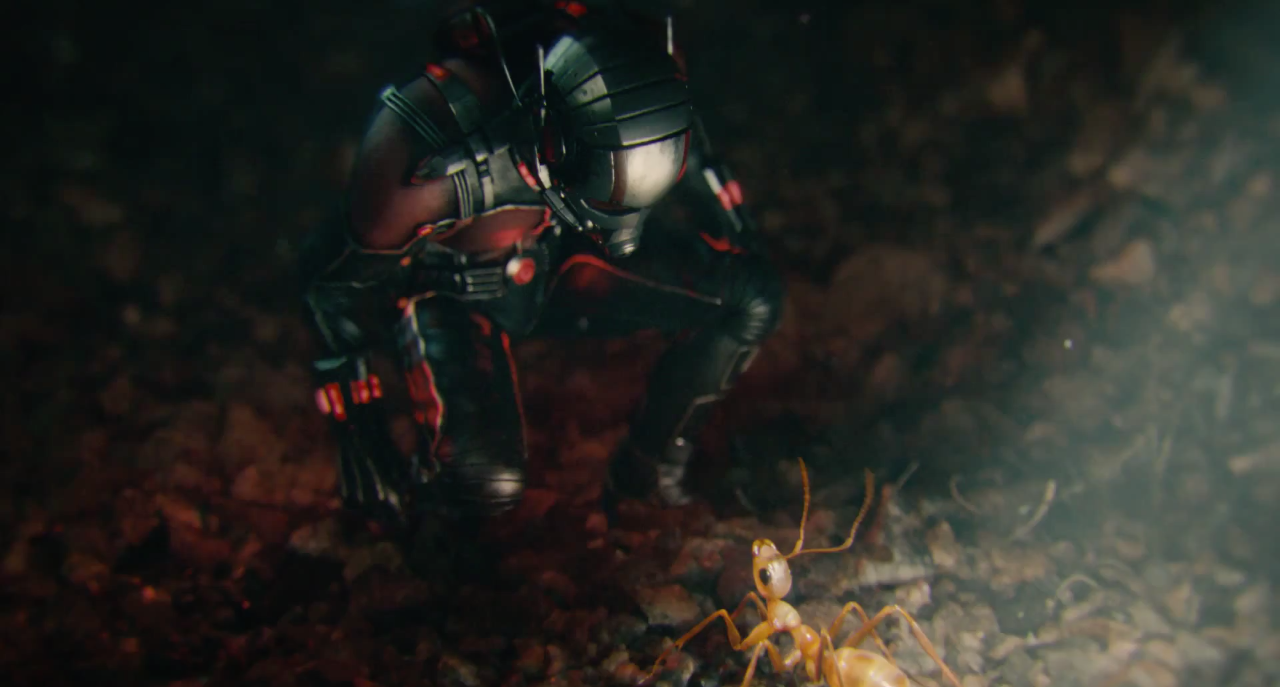
The anatomy looks pretty much dead-on for the crazy ants if you compare with the film's screencaps, which is really nice to see. They're the smallest ants of the film, and very yellow in comparison to the others; the only ones that could get mixed up are the fire ants, although they're a bit more orangey. 


Image from Youngzine.org

As you can see, they have very long legs in comparison to the others species, and are covered in short hairs across the entire body, especially the lower legs. A credit goes to the Marvel team here, as they really did study these ants and get even these small details down; you can see in the following screencap those distinctive hairs along the tarsus of the central leg.

Aw, he's adorable!

To continue on the lines of the almost-absurd nature of crazy ants, they're labelled as the ones that 'control electricity' in Ant-Man. And amazingly, it's actually true. Well, to an extent. Crazy ants don't control electricity or conduct it like they say they do, but there is a massive problem with crazy ants shorting out electrical equipment. For some insane reason they like to try and colonise the spaces inside electricals (such as plug sockets and air conditioning units), swarming inside the tiny spaces. They don't create nests, instead moving around and colonising small spaces as they go. When they all try and cram into a tiny space like the inside of a plug socket, the contact between the bodies causes the plug to short circuit between electrical contacts. It also kills all the ants. They release an alarm pheremone (probably mixed with a burning smell...) which attracts more ants, which then swarm even more, and fill up your standby computer with a lot of very antsy (see what I did there?) insects.

Not what you want to see when you're booting up for a day of Tumblr

Basically, they're pretty metal invaders. Take a moment to breathe now and thank your lucky stars they've not made it to the UK.

Carpenter Ants

Finally, we have the species that should probably be labelled as the most popular species in Ant-Man. Carpenter ants are the big guys, 'ideal for ground and air transport'. They're in the same genus as the Honeypot ant, one of the grossest (and therefore, are really fascinating) ants ever. A quick diversion; these guys gorge some workers with food, so their abdomens swell up into massive food stores (a condition called plerergate), and they can feed the rest of the colony. Ew.

They look kinda like water balloons ready to pop

Not much use to Ant-Man though. The carpenter ants that we do see, we meet one star of the show. Anthony, the loyal steed of our hero.

Yee-haw!

This bro is Anthony. Or, to be more accurately, this lady is Anthony. Or it might be Antony, I'm not entirely sure. Either way, Scott Lang calls her a boy the entire time, and she certainly is not. Anthony is actually most likely to be a queen ant; in an ant colony, there are three types of ant;
  1. Worker ants; these are all female (who knew, Ant-Man is actually a female dominated film, despite there being like only one human female character) and have a range of jobs.
  2. Male ants; these do have wings, but their sole purpose is to fertilize the female. Then they cop it. Males are fairly useless in the massive colony world.
  3. Queen ants; these girls are bigger than worker ants and males, have wings, and are the centre of the nest- they're egg layers, mass-producing new workers. That doesn't mean they 'control' the other ants though.
Every year, when you see the masses of ants swarming all over the ground, with winged ones in their midst; that's the day that virgin queens fly. Bees work in a very similar way; the queen picks her day, leaves the nest to fly, and all the males follow her in a big chase to be the one to mate with her. 


Where are we all going again?

So you could question why all the ants follow Scott in all those neat flying scenes. He's obviously gone some of that sweet queen-in-heat pheremone stashed in his suit somewhere.
Everybody loves Anthony though, which is something you never would have expected. Ants? Ew. Ants are gross. Not when you give them a name and treat them a little bit like a giant ugly puppy! So much so, Anthony has gone big- and even managed to get a toy made of herself. Now there's a privilege restricted to pretty much every other superheroine.

Buy me like 10 for my birthday.

Okay, I think I'm done. Phew, you can stop thinking about ants now. Unless you're about to go see the film, in which case, GLHF. Have a comic before you go!

Thursday, 30 July 2015

Myremecology-Man; science of Ant-Man

Probably not the story of blog post you'd expect to see from my blog, given how outdoorsy it normally is, but there you go. Yesterday I went to see Ant-Man in the cinema, and was actually quite impressed, not only with the plot, but with the accuracy of the ants. Yes, if you go see a film called Ant-Man, there are going to be ants.
A few mild spoilers to follow here and there, but mostly to do with ant behaviour.

A cleverly disguised spoiler bar

So, as Hank Pym (officially one of my most disliked characters*) states, there are 4 different ant species used in the film. Let's get our lineup...

  1. Fire ants, the builders.
  2. Bullet ants, Paraponera clavata, the ones with the nasty sting.
  3. Crazy ants -the boyfriend laughed and didn't believe they were a thing until I started correcting the science to him afterwards- the electric ones.
  4. Carpenter ants, the flying ones.
Quite a nice mixture, and certainly all familiar to an American audience; less so to a British one, but bullet and fire ants aren't unrecognizable. There was actually quite a lot of ant action to be had throughout the film, which was a nice surprise. I thought there would be a lot more general superhero action, rather than actual cool ant stuff.

*So much so I almost didn't go and see it, but was convinced by the trailers that he wouldn't have much part in it. I was wrong. Why couldn't there be Janet in there instead?


I'm going to break this one down into two parts; fire ants and bullet ants today, and then crazy ants and carpenter ants another day. Probably I'll do a further post on other miscellaneous stuff I want to mention too, like pheromones, after that, but who knows.

Fire ants

These guys were described as being great at building. The fact that they, like bullet ants, have a killer bite wasn't recognized,  but I think they were trying to simplify for those who didn't know ants (ie, the rest of the cinema) to one major fact per species.

They put the fire ants' building ability to good use though- the one I appreciated most was when they built a raft to float down a water tunnel on. This is one of the coolest protective abilities of fire ants; in nature, they have been recorded making giant rafts out of their own bodies when nests are flooded, allowing the colony to float away with the queen in the middle, and survive extreme flood events. They are able to build bridges as well, so that was cool to see, although it was quite a sooped-up, extra fast build and reform they did in the film.

Get me out of here! I'm standing on a pile of ants!

They were nice and small in comparison to the other species shown, which was happily right! Their colouring came up nicely as well, so they were easily recognizable against the more often seen carpenter ants.

Their nests aren't exactly like the ones in the picture above; they're much more triangular in shape. Because fire ants are a bit of a pest in the States, they're freely exterminated. Some people like to make art out of their nests though, which really shows off the architecture they create underground...

Not the nicest way to go

Bullet ants

Paraponera clavata, the name mangled all of too many times for my ears to cope. It probably was only about twice though, so perhaps I should give credit for trying... and the film writers actually including a latin name for one of the species. These guys were rightly labelled as the 'really painful' ones.

Oh man, and these guys bite. On the Schmidt Insect Pain Index they sit happily at the very top end. The Schmidt Index runs from 0-4, 0 being something unable to feel, to 4, which is agony. Lovely. Unfortunately Marvel got a bit confused here and labelled bullet ants as 1, but never mind.


Otherwise known as, the bad insect pets scale

These guys really can cause as much pain as was shown in the film, and Scott was pretty wise to really want to step on any of them. Really not a good species to annoy. Not only is their sting absolute agony, the pain lasts for up to 24 hours, so you are really feeling it long-term if you get on the bad side of one of these beasties. Luckily, they're pretty huge, some workers getting up to 1.2 inches long, so you're not likely to miss one if it's running around. 

bolla_4271
They can get literally this big

In one tribe in the Amazon, the initiation to become an adult is to stick your hand in a glove full of bullet ants. No thanks. 

That's all for now, although I will eventually get down to writing a part two. For now, go watch the film so I can reference more stuff in the future!


Thursday, 16 July 2015

A small update...

Work has been such a crazy ride over the past few months, I've had absolutely no time at all to write a blog post since March, apparently. But now it's starting to come to a bit of a quieter period, what with the summer starting for schools, so I actually have some time to do things like this! Commence incoming backlog of posts, probably in a bit of a weird order as I try and cram four months of posts into probably four weeks.


A selection of pictures of work... honestly!

I've been living on the Dorset coast again since February, working as a field studies tutor- which means I'm outdoors all the time (bliss!) There's loads of wildlife around and really awesome geography, so there'll be a bit of a mixture of blog posts coming up eventually. I shan't spoil it though, mostly because I am not sure what order I'm going to write them in...

Tuesday, 17 March 2015

Little Sea and Studland

It's been quiet on Dendrocopos lately because I've been really busy with lots of exciting new life changes! In short, I've just quit my old admin job, started a new field studies job, passed my driving test, and done lots of travelling up and down the country. Now I'm based down in Dorset, teaching geography in Purbeck for the next 6 months.

Studland

The most exciting adventure of this week (so far, it's only tuesday) has been a trip to Studland and Little Sea with my parents. Studland is a peninsula created over 300 years from blown sand, forming distinct dune systems with ridges and slumps. Without going into too much geological detail (mostly because I am not an expert on it!) Studland is made up from deposits of sand, silt and gravel from the sea, which has built up over years and years of deposition. Heathland has grown over the area today, creating a unique environment perfect for studying blown sand formations.

A simplified geological map of the South Haven Peninsula and Studland, Dorset, based on modern geological maps, but completely redrawn, 2014

I'm pretty familiar with Studland as it was my main research site for my dissertation! I spent about 3 months looking at wood ant nests (very closely, getting covered in ants a lot)... which is what half of this post is about! It was quite a warm day today, which meant that some of my favourite residents of Studland were active- which actually was quite surprising for me, as although the sun was out, I didn't think it would be quite warm enough for the insane numbers of Formica rufa we saw about their nests.


Ant swarms! This actually makes sense for the time of year- it's the warmest it's been for a couple of weeks today, so they've all come out to swarm and make new nests. Interestingly, on the first active nest we found, there were only ants in a select few places on the actual nest material, clustered mainly in a south easterly direction, where the sun was at that point in time! You can sort of see this in the picture above, with air holes as well where ventilation of the nest was taking place due to the massive numbers of ants clustered in one part.

Glorious microfauna

Moving on from this first nest, which was a teeming mass (to put it lightly), we moved on to one of the hides on Studland to have a quick look around to see what birds were on the lake. On the walk down to the hide, we came across this monster of a nest- not only is the nest the very dark mass of ants (literally, that's just ants!), but to the right as well, the huge flattish pine needle area. You can actually only see half of it, and there were trails all over the place as well- I'm balancing on the log there because it was the only place I could stand for more than a second and not get absolutely coated all over my legs with interested foragers and upset soldiers!

The best animals to pet

Eventually we moved on from this spectacle to take a wander down to the hide. It's tucked quite away from the road, so not many people really know about it, which makes it a pretty nice spot. There isn't a whole lot to see a lot of the time, unless you sit there for ages with a pair of strong binoculars, but there is a diary that people write their sightings in, so if you're lucky you can see marsh harrier and some nice ducks like pintail and little grebe (or dabchick). We saw a couple of great crested grebe and a couple of cormorants- and then hit the jackpot.

One of the lesser known residents of Little Sea are otters. We've been going out to this hide for the past 18 months or so (basically since we first heard about it being a good spot to otter watch), and have never seen even a tail, only the records in the aforementioned diary that there had been sightings. The last one was January 30th, so we didn't really think we'd spot one. But then, just as we were about to pack up and head off, black ripples in the water! Not just one otter, but a whole family of them swimming across the lake!


 The picture's not fantastic, but there they are! Will definitely have to be heading back again in the future to see if we can spot them again, and actually remember to take binoculars next time...

Sunday, 18 January 2015

The Monsal Trail

The third walk we did in the Peak District was the Monsal Trail in Chee Dale. This was actually supposed to be our first walk, but due to snow forecasts on the 26th (which came true!), we decided driving the dodgy Cat & Fiddle road probably wasn't a good idea on that day. Also, it had rained a fair bit on Christmas Day, which might have put a spanner in our plans. When we did head over to Buxton, even though we took the new Cat & Fiddle road, it was pretty scary driving through just white snow on every side- and that was without doing the super-dangerous old road. I have a couple of pictures from the drive back; they've got a bit of window glare on, as we didn't really want to stop when there was nowhere off the road, and certainly we weren't when the hills had some pretty huge snowclouds coming in.


On the way there though, it was gloriously bright and clear, and we could see all the way back to Macclesfield. Ben pointed out where we had been the day before; Shutlingsloe really did earn its name the Mini-Mountain, by far the steepest-sided hill on the horizon. I was amazed, because we hadn't been able to see anything at all the previous day. A flock of grouse whizzed over the fields in front of us, shrieking as they settled down beyond sight of the road.


On the way back, the clouds were so thick we couldn't even see the Cat & Fiddle pub on the side of the road until we were driving past it!


The Monsal Trail runs through Chee Dale, Miller's Dale and Cressbrook, following the river Wye. The most exciting part of the walk, that meant we had to pick a good day to walk on, is the stepping stones that makes up the path at a couple of points along the riverside- they're fairly high above the waterline in the summer, but in the winter when there's a lot of rain, the trail can become impassable as the river level picks up. We parked at Blackwell Mill, which was super-icy (enough to cause a couple of cars to wheelspin horribly when they tried to get out, although they didn't really have the right technique on complete ice), and walked down to the river. Immediately we found we were going to have a bit of difficulty with the trail...


But we persevered, whether through foolishness or adventure. If the trail becomes completely impassable, there are regular crossings of the river under the old dismantled railway, so it's easy to double back and get up onto high ground to continue your walk. With our first obstacle passed though, we decided that would be only the last resort, and we were definitely going to get as far as possible along the river! Also, we forgot our map, so just following the river was the easiest thing to do.

There are multiple old viaducts along the river walk

Anyway, we set out along it, not really paying attention to how far we were going, just making sure we kinda knew we weren't going to get stuck anywhere (permanently). The snow made it difficult to see the muddy spots, and ice made some bits where water had dripped down onto the path slippery, but we made it! Following the path (which both sets of our parents would have deemed 'too unsafe' to continue along a long time previously), we finally found the first set of stepping stones!


They were almost underwater and there was nobody else around- so nobody else to embarass ourselves in front of in case we fell in, right?- we slowly made our way across to some excitement. Then, further along, another set! These, I got one foot a bit wet with as one or two were definitely underwater, but not enough for us to get dissuaded.


There were only a handful of other people walking, which meant my bird count was through the roof. Long-tailed tits, blue tits, great tits and coal tits filled the trees, with their companion calls one of the loudest noises, next to the sound of the river. Robins and blackbirds also made their appearances, the robins especially Christmassy against the snow. Saving the most exciting until last though, we spotted maybe five or six Dippers along the river, taking off with a blur of white and black!

Super undercutting of the gorge

The path didn't get any easier the further we went along- if anything, it was more difficult as the gorge tightened and we were forced right alongside the river up on a slope at some points. It's a limestone gorge; lime kilns can still be seen alongside the old railway line today. The sides of the river are steep and difficult to walk at points- this is not a light walk! You can read more about the geology and biology of the area here. Anyway, we managed to get along alright, then we came across this rather large obstacle...


We knew we could get across because a couple had come across with their dogs only a little bit before, and we had come much too far to turn around now. So, very slowly, we crossed the network of fallen branches and logs that now made up the 'path', until... yes!

If you can't work it out, this was the other side

Feeling victorious after this, the rest of the path was 'easy', and we emerged out at Miller's Dale station, not nearly as far as we were expected to get in the amount of time that we had been walking, but pleased none the less. The view from the old viaduct was great, and the old railway tracks made a super-quick and easy walk back.

The old Miller's Dale viaduct

The railway closed in 1967, although the main buildings from the station remain; it served as an important transport connection for Buxton to London and Manchester. There was even a Post Office on the platform! It's not there any more though. Walking back towards Blackwell Mill, you can follow the railway line the whole way, which is a much straighter and flatter route than the riverside walk. The few tunnels sped up our progress even more, because it meant not having to trek through a foot of snow!


It only took us about 1/2 hour to walk back along the train line, what had taken us 2 1/2 hours to get to following the river gorge. And, we managed to get out of the car park in one piece!

Monday, 12 January 2015

The Mini-Mountain

Ridgegate Reservoir

The second of our Peak District walks was Macclesfield Forest and Shutlingsloe hill. Heading towards the Peak District, we knew there'd be a lot of snow- there were still big snow clouds lingering from Boxing Day night (Boxing Night?), but we didn't quite realise how much there would be once we got up into the hills. Macclesfield had had a bit of snow, but no more than a few centimetres at best. So, when we got out the car and put on our boots at Ridgegate Reservoir, although the road was icy and there was a lot of snow in the forest, even then we didn't understand the amount of snow we were going to come across.
For reference, the walk we did should have taken around 2-4 hours, depending on walking pace and stops. In the very difficult weather, it took us around 6-7 hours. We did stop at the Hanging Gate pub for a fairly long time though.


Macclesfield Forest is owned by the Forestry Commission, and is used as a source of timber and water, from the two nearby reservoirs.It also has important leisure and wildlife connections. Primarily spruce, it provides habitat for goldcrest, crossbills and other coniferous-loving species. We headed up the red route towards Shutlingsloe through the forest, and quickly found that there was a lot more snow up here than there was in the middle of town!


Despite this, it was fairly busy in the forest, until we came to the footpath up to Shutlingsloe peak. Apparently another name for it is the mini-mountain, which, as I found out the following day, when we drove past and visibility across the Peak District was much better, was very very apt. It's 1,660ft high, and pretty much the epitome of a mountain in all but height. Straight up one side, straight down the other- when we came to it, through white-out snowclouds, there were a few people sledging, which made me think it was less steep than it actually was.

The bottom of Shutlingsloe

Then, I saw the path, disappearing up at a 45' angle, and realised we were in for a climb, rather than a walk. It was a trek up that can't really be put into words, so hopefully a few pictures will do it justice...


The top was sheer white-out, with none of the view to be seen. The path down the other side towards Wildboarclough was difficult to find through the masses of snow- there are actually two paths, one that's very steep, and one that felt very steep, but apparently wasn't quite as bad. In the thick snow that came up to our knees at points, it was pretty treacherous. It's not a walk for those who have any difficulty in walking difficult routes, because under the snow there were still tufts of grass, rocky bits and very steep parts of the path. Which I assume we were on, as most of the time we ended up just following previous walkers' tracks, and hoping we wouldn't trip and cause a broken ankle. There was no way of avoiding falling over completely, and more than once we both found ourselves covered in snow after a slip!

The 'view' at the top!

At the bottom the path ran down to Wildboarclough, and a small pub, the Crag Inn. We didn't stop as we had a long way to walk still, heading up through the fields on a footpath. This again, was popular with sledges and snowboarders! A couple of kestrels sat on the electricity wires near Sheepclough Gutter. We found a few more snowmen along the walk as well, and a big buzzard got disturbed on our approach to one of the remote farms found out in a valley.

The walk back from Wildboarclough

It was starting to get dull by the time we got to the last crest of hill and saw the Hanging Gate pub in front of us- caution had paid off, as we would have had a very long walk in failing light across hills if we had stopped at the Crag Inn! This last part of path was extremely muddy though, and a bit of a challenge to get down without getting stuck.


Happily we both kept our boots though, and found the Hanging Gate was tiny, but served hot chips and had a fire to dry our coats out a little bit by.


When we left it was dark, so I don't have any pictures of the walk back along the country lane to the car. It was very straightforward though (literally), and not difficult to walk at all. The snow clouds had cleared by this time (it was about 5.30pm), and the sky was utterly dark, with the stars really bright. The moon was only half-full, but we could see our shadows as we had our back to it walking along, which meant we kept checking back to make sure there wasn't a car on it's way! Thankfully it was very quiet, and we made it back to the reservoir fairly quickly for about 6pm. The last car there, there was none of the tricky parking that we had had to do in the morning!

Tuesday, 6 January 2015

The Shivering Mountain

Been on a bit of a hiatus over the holiday season, because I've been so busy travelling up and down the country and enjoying the (fairly good) weather! A large part of my holiday I was in the Peak District, so the next few posts are going to be from there.

On Boxing Day (my birthday), we headed to the Peak District from Macclesfield to Mam Tor. Mam Tor is a fairly massive steep hill near Castleton, which you can see from the top, factory belching smoke included. The path isn't the easiest climb, but it's well maintained by the National Trust, so it's not horrendous. Once you get to the top, there's an awesome view- even with cloud- and a nice long walk along the ridge of hills.

The path from Mam Tor

It gets a bit rougher further along, but even in the mucky damp weather we had, it was alright to climb, and very busy! In good weather, you can see really far, almost to Manchester, but we had low snow clouds for the whole day, so we couldn't see that far.


It took us a couple of hours to work our way along the top of the ridge and down towards Castleton, to the east of Mam Tor. The path down was a bit difficult for us to find, as our map was a little dated. There were some pretty steep bits here and there, and lots of winter mud too, but it was okay with walking boots on!
Castleton is small- we didn't go into it really as our path diverted away along the Odin Sitch river and back towards the hills, but we did find some chickens interested in stealing bits of gingerbread...


We also came across a hare bounding through the fields as we walked through the fields! Too quick to take photos of though, it was off in a flash. Heading back up the hills, we came to one of the most interesting bits of our walk; the A625 road. Now, this might not sound exciting at first mention- after all, how can just an A-road be interesting?
Backstory time! Mam Tor is also called the Shivering Mountain, because of Mam Tor's primarily shale geology. Multiple landslips have occurred over time, causing multiple smaller hills to form on the side of the peak itself. The A625 road was built in the 1800s, but closed in 1979 due to landslips distorting the road beyond safety. Once we got there, it was instantly obvious as to why!

Cross section of part of the old tarmacked road. The drop was a good 5ft down

You can see the effort put into trying to keep the road flat and open, by the multiple levels of tarmac put onto the road! It's ruined now, although a couple of cars did follow us up quite a long way along the driveable part of the road... which was concerning, when you couldn't see the drop in the previous picture until you were literally standing on it!


We didn't stick around for too long, as it was fairly late by the time we got to the road, and the snow clouds were starting to close in more and more. So, these are annoyingly the only two pictures I have! By the time we got back to the car though, it was dark. And, an extra-special birthday surprise, it started to snow when we were walking along the last (driveable) road to the National Trust car park for Mam Tor!

You can find the approximate route for the walk we did on the National Trust's page.